


Teeth Whitening Mouthwash - White in Minutes® Rinse
Teeth Whitening Mouthwash - White in Minutes® Rinse
4.83 / 5.0
(6) 6 total reviews
Couldn't load pickup availability
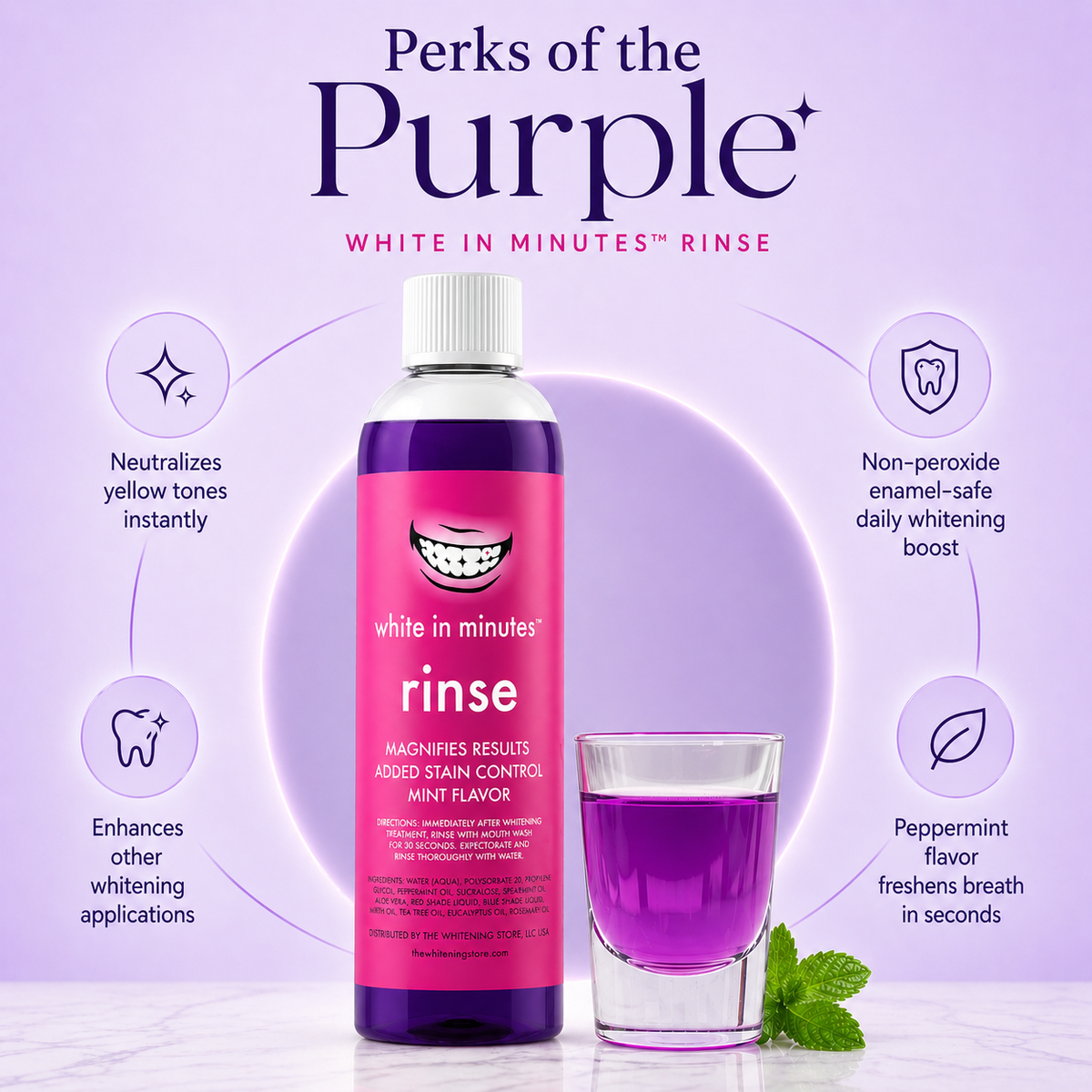
Take your whitening results from good to unreal in seconds. White in Minutes Purple Whitening Mouthwash is a post-whitening essential designed to instantly enhance brightness, neutralize yellow tones, and give your smile that ultra-clean, just-whitened look. Think of it as the finishing step your whitening routine has been missing.
Why You’ll Love It
- Instantly makes teeth look whiter
- Neutralizes yellow tones using purple color correction
-
Enhances results after any whitening treatment
- Leaves breath fresh with a clean mint finish
- Supports gum health and helps reduce tartar buildup
- Perfect for at-home and professional whitening routines
How Purple Mouthwash Works
This isn’t a traditional whitening mouthwash. It’s smarter.
Using color-correcting technology, this purple rinse works the same way luxury beauty products tone brassiness. Purple sits opposite yellow on the color wheel, so it visually cancels out warm tones on your teeth.
The Result
Teeth that appear noticeably whiter, brighter, and more polished immediately after use
It also reflects light in a way that enhances brightness, giving your smile that high-gloss, almost airbrushed finish.
When to Use It
- Right after any teeth whitening treatment
- Before events, photos, or nights out
- Anytime your smile needs a quick refresh
How to Use WIM Whitening Mouthwash
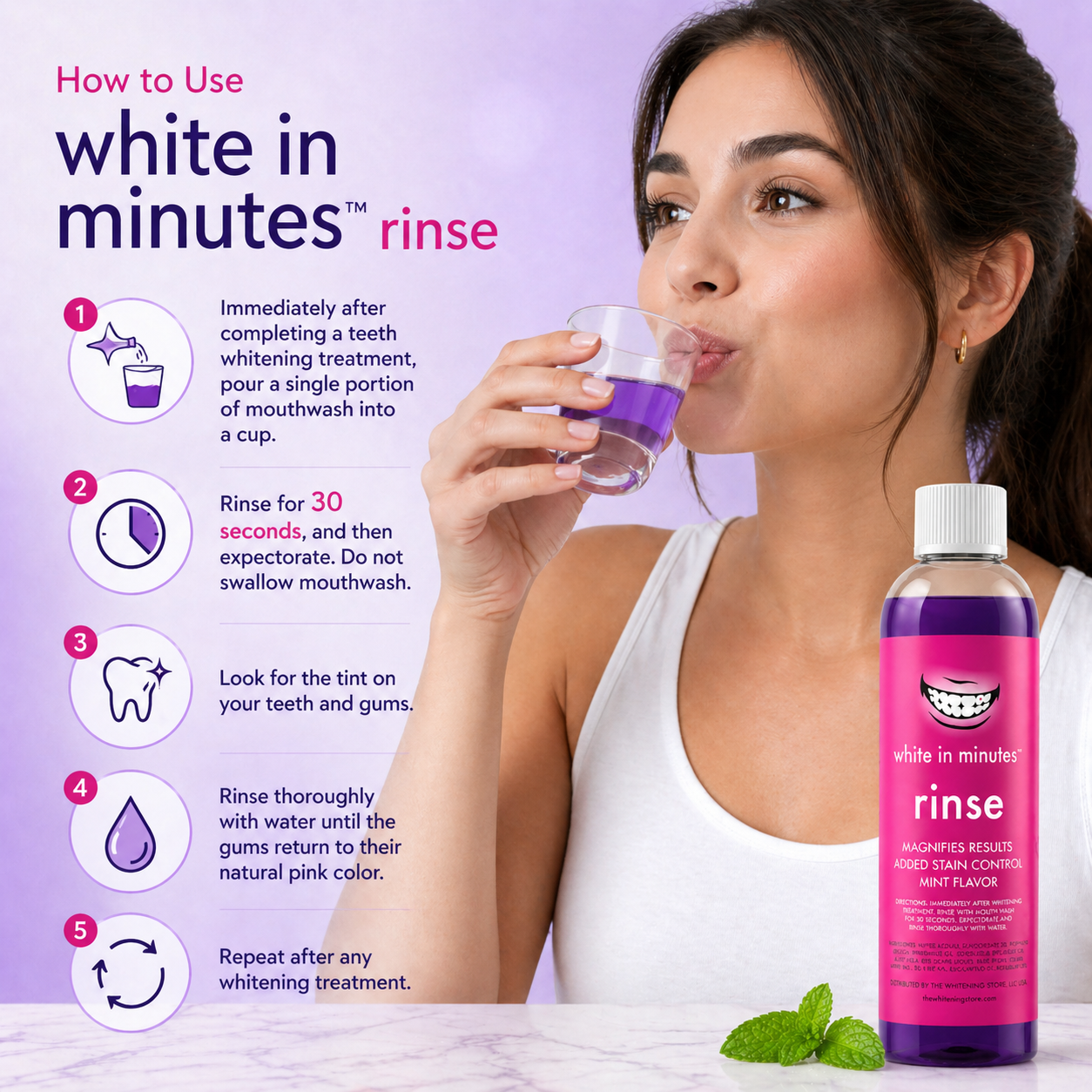
- Pour a small portion into a cup
- Rinse for 30 seconds after whitening
- Spit, do not swallow
- Lightly rinse with water until gums return to their natural color
Pro Tip
The subtle tint is what creates the brightening effect. Don’t panic, it’s doing exactly what it should.
Size
6 oz bottle (Approximately 12 uses, 0.5 oz per rinse)
Ingredients
Water, Polysorbate 20, Propylene Glycol, Peppermint Oil, Sucralose, Spearmint Oil, Aloe Vera, Red Shade Liquid, Blue Shade Liquid, Myrrh Oil, Tea Tree Oil, Eucalyptus Oil, Rosemary Oil

Gingival Barrier FAQ's
What is gingival barrier gel?
Gingival barrier gel is a light-cured resin used to protect the gums and surrounding soft tissue during professional teeth whitening treatments.
Once cured with a dental curing lamp, it creates a temporary protective shield between whitening gel and the gingival tissue.
Is gingival barrier gel the same as a gum dam or liquid dam?
Yes. Gingival barrier gel is also commonly referred to as a gum dam, liquid dam, gingival dam, gum barrier, or gum protector. These terms all describe a protective resin used to isolate soft tissue during whitening procedures.
Why is gingival barrier gel used during teeth whitening?
Professional-strength whitening gels can cause irritation if they come into contact with the gums. Gingival barrier gel helps isolate and protect soft tissue, creating a safer and more comfortable whitening experience for the patient.
Do I need gingival barrier gel when using hydrogen peroxide whitening gel?
Yes. Gingival barrier gel is strongly recommended whenever high-strength hydrogen peroxide whitening gels are used in professional whitening treatments because hydrogen peroxide can irritate soft tissue if proper isolation is not maintained.
Can gingival barrier gel be used with carbamide peroxide whitening gel?
Yes. Gingival barrier gel may be used with both hydrogen peroxide and carbamide peroxide whitening gels whenever soft tissue protection is desired.
What is the difference between gingival barrier gel and a rubber dam?
A rubber dam is a physical sheet used to isolate teeth during various dental procedures, while gingival barrier gel is a light-cured resin that is applied directly to the gum line.
Gingival barrier gel is often preferred during teeth whitening because it is faster to apply, more comfortable for patients, and allows easier access to the treatment area.
How long does gingival barrier gel take to cure?
Most gingival barrier gels cure within approximately 10 seconds when exposed to an appropriate dental curing light. Cure times may vary depending on the curing lamp being used.
What type of curing light is needed?
A standard dental curing lamp is required to properly harden gingival barrier gel. Always follow the curing light manufacturer's instructions for optimal curing times.
Purchase our iLED 1-second curing light HERE.
Can whitening gel burn gums?
Yes - and no. If high-strength whitening gel contacts the gums, temporary irritation or whitening of the tissue may occur. Lower strength gels are less likely to cause irritation to the soft tissue.
Proper application of gingival barrier gel helps reduce the risk of soft tissue irritation during whitening treatments.
How do I apply gingival barrier gel?
After cleaning and drying the treatment area, apply a thin continuous bead directly along the gingival margin and between teeth where needed. Cure the material with a dental curing lamp until hardened before applying whitening gel.
How do I apply gingival barrier gel?
After cleaning and drying the treatment area, apply a thin continuous bead directly along the gingival margin and between teeth where needed. Cure the material with a dental curing lamp until hardened before applying whitening gel.
How do I apply gingival barrier gel?
After cleaning and drying the treatment area, apply a thin continuous bead directly along the gingival margin and between teeth where needed. Cure the material with a dental curing lamp until hardened before applying whitening gel.
How do I apply gingival barrier gel?
After cleaning and drying the treatment area, apply a thin continuous bead directly along the gingival margin and between teeth where needed. Cure the material with a dental curing lamp until hardened before applying whitening gel.
How do I apply gingival barrier gel?
After cleaning and drying the treatment area, apply a thin continuous bead directly along the gingival margin and between teeth where needed. Cure the material with a dental curing lamp until hardened before applying whitening gel.
How many whitening treatments can be completed with one syringe?
The number of treatments varies based on application thickness and provider technique. Applying a thin, controlled bead along the gingival margin helps maximize product efficiency while maintaining adequate protection.
For sanitary reason, do not reuse gingival barrier syringes tips on more than 1 person.
Who uses gingival barrier gel?
Gingival barrier gel is commonly used by dentists, dental hygienists, whitening studios, cosmetic dental professionals, med spas, and trained teeth whitening practitioners in accordance with local regulations.
Gingival barrier gel is not for use at home or outside professional whitening applications.
Does gingival barrier gel replace cheek retractors?
No. Gingival barrier gel and cheek retractors serve different purposes. Cheek retractors help keep lips and cheeks away from the treatment area, while gingival barrier gel specifically protects the gum tissue. They are often used together during professional whitening treatments.
How should gingival barrier gel be stored?
Store gingival barrier gel in a cool, dry location away from direct sunlight and excessive heat. Replace the cap immediately after use and follow all storage instructions provided with the product.
Gets the job done!
Excelente producto, Un sabor mentolado fresco , veo cambios muy rápidos , úsenlo , lo más importante que no causa sensibilidad en mis diente y me termina de ayudar con mi blanqueamiento dental !
Nos alegra mucho saber que le gustan nuestros productos. ¡Siga sonriendo!
Very effective and strong mint flavor only a small amount to rinse your mouth.
As a coffee drinker, this helps to keep teeth bright and white. I use it along with the Teeth Whitening Gel.
Just got an email that this is back in stock again and I WILL be buying a few this time. Really noticed a difference in my teeth overall brightness - I drink coffee and red wine this helps with that kind fo staining.
Shop Small. Smile Big.
We’re a woman-owned, independently run small business that believes beauty should be ethical, inclusive, and empowering. Since 2012, we’ve built trusted relationships with customers and professionals who care about quality as much as we do.
Our whitening products are made with FDA-certified ingredients, sourced from diverse and responsible suppliers, and never sold in big-box stores.
Every order supports transparent practices, small-batch production, and a team that values integrity, equality, and confidence - because your smile deserves care from real people, not corporations.